Secondary School / Junior College Teaching Toolkits
For MOE teachers, please download your teaching toolkits by clicking
(Please first sign up with your MOE email account).
For MOE teachers, please download your teaching toolkits by clicking
(Please first sign up with your MOE email account).
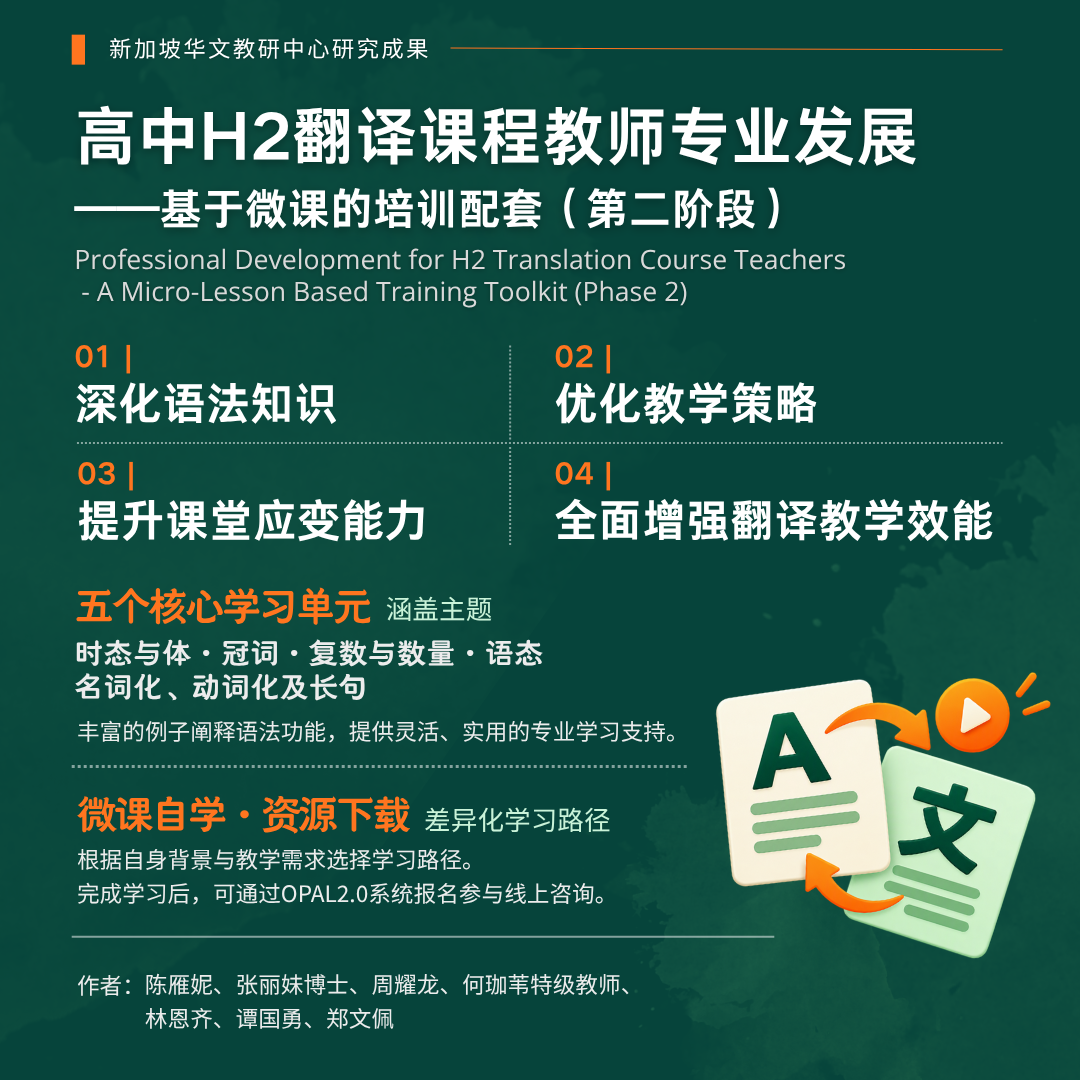
This microlearning toolkit, developed by the Singapore Centre for Chinese Language for teachers of H2 Translation at the junior college level, builds on the first phase of training to deepen teachers' understanding of the role of grammar in translation. It comprises five core units covering topics such as tense and aspect, articles, plurals and quantity, voice, nominalisation, verbalisation, and long sentences. Through a wide range of examples illustrating grammatical functions, the package prov ...
This microlearning toolkit, developed by the Singapore Centre for Chinese Language for teachers of H2 Translation at the junior college level, builds on the first phase of training to deepen teachers' understanding of the role of grammar in translation. It comprises five core units covering topics such as tense and aspect, articles, plurals and quantity, voice, nominalisation, verbalisation, and long sentences. Through a wide range of examples illustrating grammatical functions, the package provides flexible and practical support for teachers' professional learning. Teachers can download the materials for self-paced video learning and, upon completion, register on the OPAL2.0 platform for optional online consultation sessions. The toolkit also offers differentiated support, allowing teachers to tailor their learning based on individual backgrounds and professional needs. With curated reading lists and references, it encourages continued professional growth. Overall, this toolkit supports teachers in deepening their grammatical knowledge, refining instructional strategies, and improving classroom adaptability—enhancing the overall effectiveness of translation teaching.
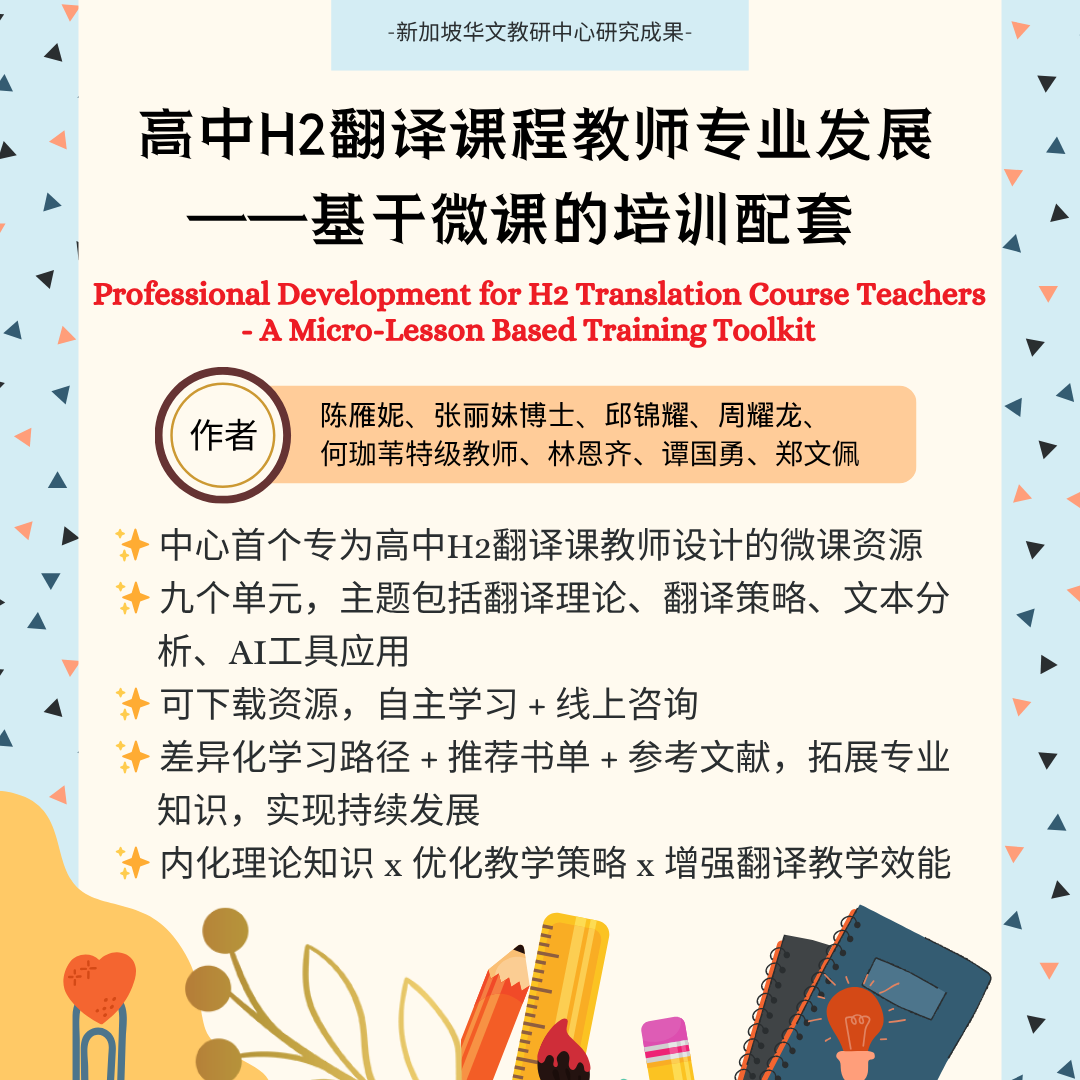
This microlearning toolkit is the Singapore Centre for Chinese Language's first resource designed specifically for H2 Translation teachers at the junior college level, serving as a tool for professional development. It consists of nine core units covering topics such as translation theory, strategies, text analysis, and the application of AI tools. Each unit integrates practical teaching examples to provide flexible and actionable training support. Teachers can download the materials for self-pa ...
This microlearning toolkit is the Singapore Centre for Chinese Language's first resource designed specifically for H2 Translation teachers at the junior college level, serving as a tool for professional development. It consists of nine core units covering topics such as translation theory, strategies, text analysis, and the application of AI tools. Each unit integrates practical teaching examples to provide flexible and actionable training support. Teachers can download the materials for self-paced video learning and, upon completion, register on the OPAL2.0 platform for optional online consultation sessions. The toolkit also offers differentiated support, allowing teachers to tailor their learning based on individual backgrounds and professional needs. With curated reading lists and references, it encourages continued professional growth. Overall, this toolkit supports teachers in internalising theoretical concepts, refining instructional strategies, and improving classroom adaptability—enhancing the overall effectiveness of translation teaching.
The toolkit is designed to complement the "Cultural Station" in the Chinese Textbook Hua Wen Ban Wo Xing(华文伴我行), featuring eight units of classroom learning activities (such as role-playing, group discussions, task completion, etc.). The main goals are to enhance students' oral expression, promote critical thinking, independent thought, and information integration skills. The contents of each unit in the Textbook are organically linked, allowing other sections to leverage the "Cultural ...
The toolkit is designed to complement the "Cultural Station" in the Chinese Textbook Hua Wen Ban Wo Xing(华文伴我行), featuring eight units of classroom learning activities (such as role-playing, group discussions, task completion, etc.). The main goals are to enhance students' oral expression, promote critical thinking, independent thought, and information integration skills. The contents of each unit in the Textbook are organically linked, allowing other sections to leverage the "Cultural Station". By effectively utilising the "Cultural Station" resources in the Textbook through meticulously designed classroom activities, this toolkit can strengthen the linkage between the different sections of the Textbook and facilitate the learning and mastery of language as well as the understanding and experience of cultural practices. By integrating cultural knowledge with real-life scenarios, the toolkit enables students to connect new knowledge with their existing experiences for practical application. This not only enhances their interest in learning Chinese but also helps cultivate cultural sensitivity and identity formation. The collaboration of the Sun Yat Sen Nanyang Memorial Hall has further enriched the cultural content of the toolkit and enhanced its relevance to the local community.
The toolkit comprises eight units, complete with lesson plans and PPTs. Beside targeted teaching strategies, useful scaffolds, and appropriate teaching activities, the toolkit also provides teachers with a range of cultural teaching resources aligned with the curriculum standards, including cultural background materials, case studies, and multimedia materials. All these help to enrich cultural knowledge in the classroom and enhance teaching effectiveness.
Designed mainly for teachers of Higher Chinese classes in secondary schools, this toolkit also serves as a useful tool for Chinese language teachers of corresponding levels in other courses.
Developed by Singapore Centre for Chinese Language, the "Bridging Picture-based Composition and Topic-based Composition Writing" teaching toolkit provides useful supplementary teaching materials for teachers of upper primary schools and lower secondary schools. It can also be used for school-based curriculum. This toolkit focuses on teaching writing from perspectives of content and structure. It aims to help students mobilize their prior knowledge and experience in writing picture-based composi ...
Developed by Singapore Centre for Chinese Language, the "Bridging Picture-based Composition and Topic-based Composition Writing" teaching toolkit provides useful supplementary teaching materials for teachers of upper primary schools and lower secondary schools. It can also be used for school-based curriculum.
This toolkit focuses on teaching writing from perspectives of content and structure. It aims to help students mobilize their prior knowledge and experience in writing picture-based composition and apply them to topic-based composition writing. With this toolkit, teachers can systematically teach topic-based composition writing, and target at students' difficulties to guide them through writing compositions.
The toolkit comprises 6 units, each including lesson plans, PowerPoint slides and activity sheets. In addition, each lesson plan is accompanied by a detailed explanation of the design rationale behind the lesson plan and teaching activities. Teachers can also refer to the theory, strategy and instructional design in the toolkit to better understand the basic teaching principles.
This handbook is a culmination of the authors' three-year research and development effort into blended learning for in-service Chinese Language (CL) teachers' professional development. The primary audience of this handbook is teacher educators who would like to learn about blended learning as an approach for in-service teachers' courses. Chapter One introduces the definition and theoretical underpinnings of blended learning. Chapter Two covers the model of blended learning the authors used, its ...
This handbook is a culmination of the authors' three-year research and development effort into blended learning for in-service Chinese Language (CL) teachers' professional development. The primary audience of this handbook is teacher educators who would like to learn about blended learning as an approach for in-service teachers' courses. Chapter One introduces the definition and theoretical underpinnings of blended learning. Chapter Two covers the model of blended learning the authors used, its design principles, and the relevant strategies. Chapter Three shares the findings on how blended learning had impacted some of the teacher-participants. Chapter Four, written by three highly experienced CL Master Teachers, captures their individual first-hand reflections and experiences of blended learning for teachers' professional development. Finally, Chapter Five provides a brief conclusion to the handbook.
Built on the basis of the research project "Developing Task-based Learning on the iMTL Portal to Strengthen Students' Oral and Written Interaction Proficiency: An Exploratory Study with Upper Secondary CLB Students" by the Ministry of Education, this teaching toolkit is tailored for the Secondary 3 Chinese Language (Express) curriculum. It features a wide variety of resources, including lesson plans, PowerPoint slides, activity sheets, supplementary teaching activities, as well as oral samples ...
Built on the basis of the research project "Developing Task-based Learning on the iMTL Portal to Strengthen Students' Oral and Written Interaction Proficiency: An Exploratory Study with Upper Secondary CLB Students" by the Ministry of Education, this teaching toolkit is tailored for the Secondary 3 Chinese Language (Express) curriculum.
It features a wide variety of resources, including lesson plans, PowerPoint slides, activity sheets, supplementary teaching activities, as well as oral samples and rubrics. Ten videos clips are also provided and uploaded to the iMTL portal for easy access. The themes of seven of the videos correspond closely to seven lessons in Secondary 3 Chinese textbooks (Express), while those of the remaining three are relatively independent.
This toolkit will be helpful for teachers to conduct textbook-based lessons on oral and written interaction, and effectively improve students' oral and written interaction skills.
Developed by Singapore Centre for Chinese Language, the "Drama is the Laboratory of Learning Chinese as a Second Language" teaching toolkit (Updated Version) is designed for use in the teaching of Chinese language in primary and secondary schools. The toolkit comprises two parts: the Written Part and the Demonstrative Videos. The Written Part begins with an introduction to the theories of drama in education and their application processes. It continues with an exploration of how drama can be in ...
Developed by Singapore Centre for Chinese Language, the "Drama is the Laboratory of Learning Chinese as a Second Language" teaching toolkit (Updated Version) is designed for use in the teaching of Chinese language in primary and secondary schools. The toolkit comprises two parts: the Written Part and the Demonstrative Videos.
The Written Part begins with an introduction to the theories of drama in education and their application processes. It continues with an exploration of how drama can be integrated in the teaching and learning of Chinese, followed by a concise account of eight common drama conventions. The accompanying lesson plans, 7 for secondary school and 3 for primary school, give teachers a concrete idea of how the drama conventions can be applied in the Chinese classroom. Samples of students' compositions written with the aid of drama conventions are also appended.
The Video Section comprises the interviews of participant teachers and students as well as examples demonstrating how the drama conventions are used in the classroom. There are 13 videos in the toolkit.
The Written Explanations together with the Demonstrative Videos in the toolkit equip teachers with a deeper understanding of how drama can effectively be integrated in Chinese language teaching. The toolkit aims to change the stereotype concepts of the use of drama in education and ultimately promote drama pedagogy in Chinese language education.
This toolkit is the product of the school-based research "Improving Chinese Speech Fluency through Formulaic Language Teaching" carried out by SCCL in 2012. It aims to serve as a reference for Chinese language teachers who are interested in formulaic language teaching. The toolkit explores the implementation of formulaic language teaching in Chinese lessons. With the gearing of speakers' language production towards automation as the core strategy, this toolkit intends to improve learners' oral ...
This toolkit is the product of the school-based research "Improving Chinese Speech Fluency through Formulaic Language Teaching" carried out by SCCL in 2012. It aims to serve as a reference for Chinese language teachers who are interested in formulaic language teaching.
The toolkit explores the implementation of formulaic language teaching in Chinese lessons. With the gearing of speakers' language production towards automation as the core strategy, this toolkit intends to improve learners' oral fluency through three related and progressive sections, namely, formulaic language recognition, practice and application.
Included in this toolkit are the theoretical framework, the teaching strategy and procedure as well as ten lesson plans. Emphasizing on practical skills, the lesson plans provided in the toolkit follow closely with the contents in MOE textbooks and can be integrated into daily Chinese lessons. Teachers can also make appropriate adjustments according to students' traits and language levels.