


- Home
- What's On
- Newsletter
- Volume 13
- Latest Publication
Volume 13 -
Apr 2013
Latest Publication
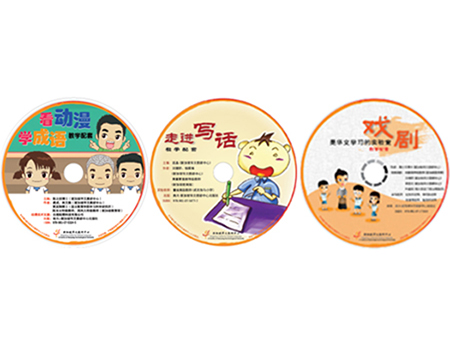 (i) (ii) (iii)
| (i) "Teaching Chinese Idioms with Animation" Teaching Toolkit | |
| Main author: | Dr Chin Chee Kuen (Singapore Centre for Chinese Language) |
| Co-authors: | Mdm Gong Cheng, Mdm Tay Boon Pei (Singapore Centre for Chinese Language) Dr Wong Lung Hsiang (Learning Sciences Lab, National Institute of Education) Mdm Tan Geok Hoon (Master Teacher, Ministry of Education) Mdm Chow Fong Yee (Master Teacher, Ministry of Education) |
| Technical support: | Taiwan Lu Feng Technology |
| Publisher: | NTU-SCCL Press, 2013 |
Developed by the Singapore Centre for Chinese Language, the "Teaching Chinese Idioms with Animation" teaching toolkit is designed for use by Primary 3 to 6 Chinese language teachers when teaching Chinese idioms. They may use the toolkit as teaching aid or school-based teaching material.
Comprising 13 lesson plans, PowerPoint presentations as well as the respective network link addresses for the 48 animations specially created by Lu Feng Technology, the toolkit caters for the learning needs of primary school students in Singapore. Students would be able to master 48 idioms while watching the animations, their interest in Chinese thus stimulated.
Each of the 13 lesson plans comes in two versions, catering to pupils of different levels of proficiency. The lesson plans demonstrate 13 different strategies to teach Chinese idioms. Appended to each lesson plan is a short essay explaining the educational theory behind the strategy adopted. These strategies are effective not only for the teaching of Chinese idioms, but are also useful for the teaching of Chinese vocabulary in general. This toolkit is therefore not only beneficial to students but also teachers.
| (ii) "Elementary Writing" Teaching Toolkit | |
| Main author: | Mdm Yan Jing (Singapore Centre for Chinese Language) |
| Co-authors: | Mdm Liu Zengjiao, Mdm Yang Silin (Singapore Centre for Chinese Language) Mdm Ng Tai Cheen (Principal Master Teacher, Ministry of Education) |
| Collaborative teacher: | Mdm Dong Yan (Bukit Timah Primary School) |
| Publisher: | NTU-SCCL Press, 2013 |
Developed by the Singapore Centre for Chinese Language, the "Elementary Writing" teaching toolkit is designed for use in lower Primary Chinese language lessons. The product of a collaborative school-based research project by the SCCL and the Bukit Timah Primary School, this toolkit exemplifies the innovative concept of "Research-Validation-Training" advocated by the SCCL.
The toolkit comprises ten lesson plans and the accompanying student activity sheets. The lesson plans will be a handy guide for primary school Chinese language teachers when teaching writing. The student activity sheets are fully illustrated with interesting cartoons which will certainly attract the students.
The toolkit provides a systematic approach to the teaching of elementary writing. Students will learn basic writing skills in stages, beginning with sentence writing and moving onto paragraph writing. The first five lessons introduce some basic sentence patterns used in narration while the remaining lessons help students grasp the essential elements and basic structure of the narrative. It is a most useful toolkit for lower primary Chinese language teachers.
| (iii) "Drama is the Laboratory of Learning Chinese as a Second Language" Teaching Toolkit | |
| Main author: | Dr Chou Shiao-Yuh (Singapore Centre for Chinese Language) |
| Co-authors: | Mr Lim Chin Nam (Master Teacher, Ministry of Education) Mdm Liu Zengjiao, Mr Jeremy Ng Sze Kuan (Singapore Centre for Chinese Language) Mr Tanny Yap Jian Nan (Information Engineering and Media, NTU) |
| Collaborative teachers: | Mdm Shen Mei Ling (St. Andrews Secondary School) Mdm Tam Siew Kee, Mdm Candy Neo Han Wei, Mdm See Bee Keow (Regent Secondary School) |
| Publisher: | NTU-SCCL Press, 2013 |
Developed by the Singapore Centre for Chinese Language, the "Drama is the Laboratory of Learning Chinese as a Second Language" teaching toolkit is designed for use in the teaching of Chinese language at all levels in secondary schools.
The toolkit comprises two parts: the written part and the demonstrative videos. The written part begins with an introduction to the theories of drama in education and their application process. It continues with an exploration of how drama can be integrated in the teaching and learning of Chinese. Eight commonly used drama conventions are introduced. The introductions, together with the lesson plans, give the teachers a basic idea of how the drama conventions can be applied in the Chinese classroom. Samples of students' compositions are appended.
The video section comprises interviews of participating teachers and students and videos demonstrating how the drama conventions are used in the classroom.
The written explanations together with the demonstrative videos in the toolkit aim to help the teachers acquire a basic understanding and actual experience of how drama can be integrated in Chinese language teaching. Ultimately, the toolkit aims to correct teachers' misconceptions of "applying drama" in education and ultimately promote the use of "drama as pedagogy" in Chinese language education.